The science behind the program
Tricision has worked on personalized mRNA immunotherapy for glioblastoma since 2015. This page sets out the clinical data, the technology platform, the regulatory position and the people, with the limits of each stated alongside.
Everything here is drawn from the company's investor and clinical materials as of October 2026. Where a figure is company-reported rather than peer-reviewed, it says so.
What has been measured, in whom, and against what
The lead product, tri1215, is an autologous dendritic-cell vaccine loaded with mRNA encoding Survivin, a protein expressed in over 90% of glioblastomas and almost absent from normal tissue. It is given with standard surgery and chemoradiation. The datasets below answer different questions and should not be merged into one claim.
Phase I, newly diagnosed GBM
Who was enrolled. IDH-wildtype GBM only; Karnofsky performance status above 70; gross total (R0) resection; about 33% MGMT-promoter methylated, in line with Chinese prevalence. PFS and OS are counted from the first vaccine dose. The trial began in 2025, so follow-up is short and the median will move. Adverse events recorded: six, all low grade: depression (1), reduced lymphocyte count (2), reduced neutrophils (1), rash (1), maculopapular rash (1).
| Benchmark | Median PFS | Median OS | Grade ≥3 AEs | Note |
|---|---|---|---|---|
| tri1215, Phase I low-dose cohort | 15.4 months | Not reached | None reported | Company-reported, small cohort, short follow-up |
| Stupp regimen, RT + temozolomide (2005) | 6.9 months | 14.6 months | Not compared | Historical standard-of-care benchmark, different era and population |
| SurVaxM (MimiVax), Survivin peptide vaccine | 11.4 months | 25.9 months | Not disclosed | Same target, different product format; FDA Fast Track; Phase IIb reported 2026 |
These are not head-to-head comparisons. Cross-trial numbers differ in population, timing origin and era.
Pooled analysis, investigator study plus Phase I
Registered Phase II
tri1215 is registered with China's Center for Drug Evaluation as CTR20261465 for newly diagnosed GBM. It is the only GBM mRNA vaccine at Phase II in China. Per the registry transcription, the design is open-label and single-arm, with a IIa stage for dose-limiting toxicity and recommended dose and a IIb stage with overall survival as the primary endpoint. Management targets a conditional launch in 2029. Registration is not the same as recruitment status or approval.
Four capabilities, one system
Every product shares the same four building blocks. Platform reuse lowers the cost of each new indication; clinical validation still has to be earned product by product.
triVac
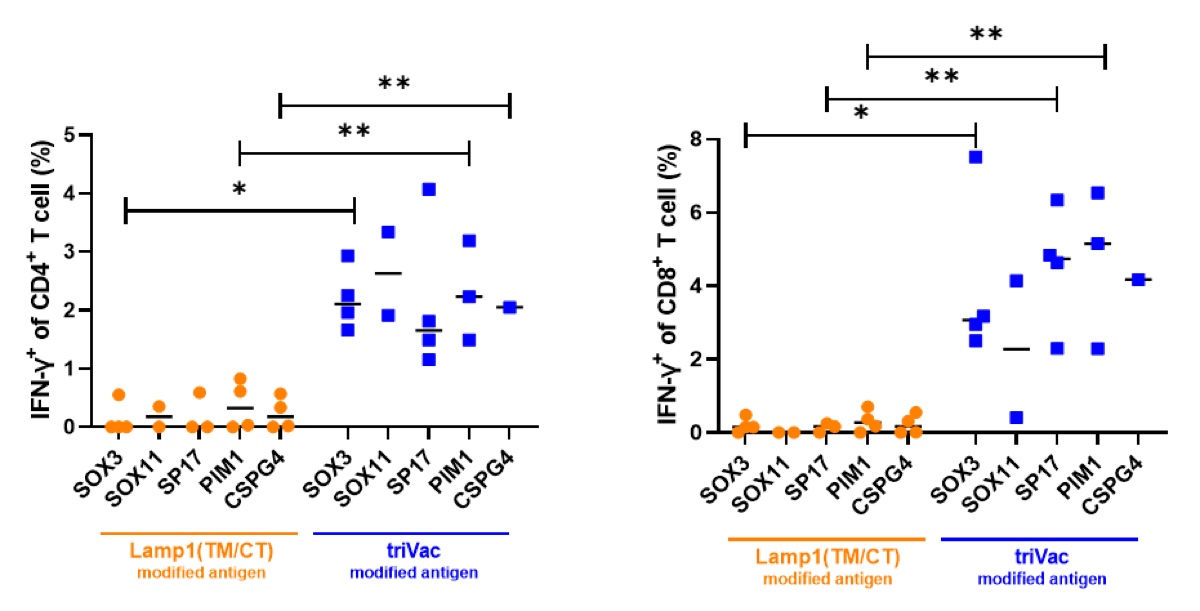
A proprietary modification of the antigen sequence (signal-sequence, LAMP and DD elements) that improves how dendritic cells process and present a target, turning low- and medium-affinity antigens into usable immune targets and sustaining memory T cells.
- Significantly higher success rate generating antigen-specific CD8⁺ T cells
- Compatible with ex vivo DC loading and in vivo mRNA-LNP delivery
- US patent granted; recognized in China's disruptive-technology competition
C2-tLNP, cDC1-targeted lipid nanoparticle
A proprietary ionizable lipid (C2) and formulation designed to carry mRNA to type-1 conventional dendritic cells, the subset that primes anti-tumor T cells, inside the body.
- Selectivity for cDC1 over cDC2 and plasmacytoid DC in human PBMC
- Lymph-node cDC1 targeting after intramuscular dosing in cynomolgus monkeys
- US patent 12,508,225 B2 granted December 2025; patents in 21 countries; freedom-to-operate analysis 2021
- Lyophilizable; microfluidic manufacturing; low-dose, needle-free compatible
Human-cell and primate data are preclinical. The company describes this as the first cDC1-targeted lipid delivery system.
AI-assisted antigen bank for Chinese populations
Self-developed algorithms screen tumor targets using Chinese patient and population data, built with Guoxin Health into a shared-antigen bank.
- Selected for the Ministry of Industry and Information Technology's AI industry innovation program, June 2026
- Shared antigens support standardized vaccines alongside fully personalized neoantigen designs
GMP from raw materials to patient cells
In-house production of enzymes and plasmids, mRNA, lipid formulations and autologous DC products, with batch records and quality release for every dose.
- China's first GMP-grade mRNA production line; ISO 9001 certified
- China's first lyophilized mRNA platform, on the 2022 Innovation China list
- Closed-system robotic cell processing under deployment (August 2026), estimated 30–50% cost reduction
A vaccine at the center of the cancer-immunity cycle
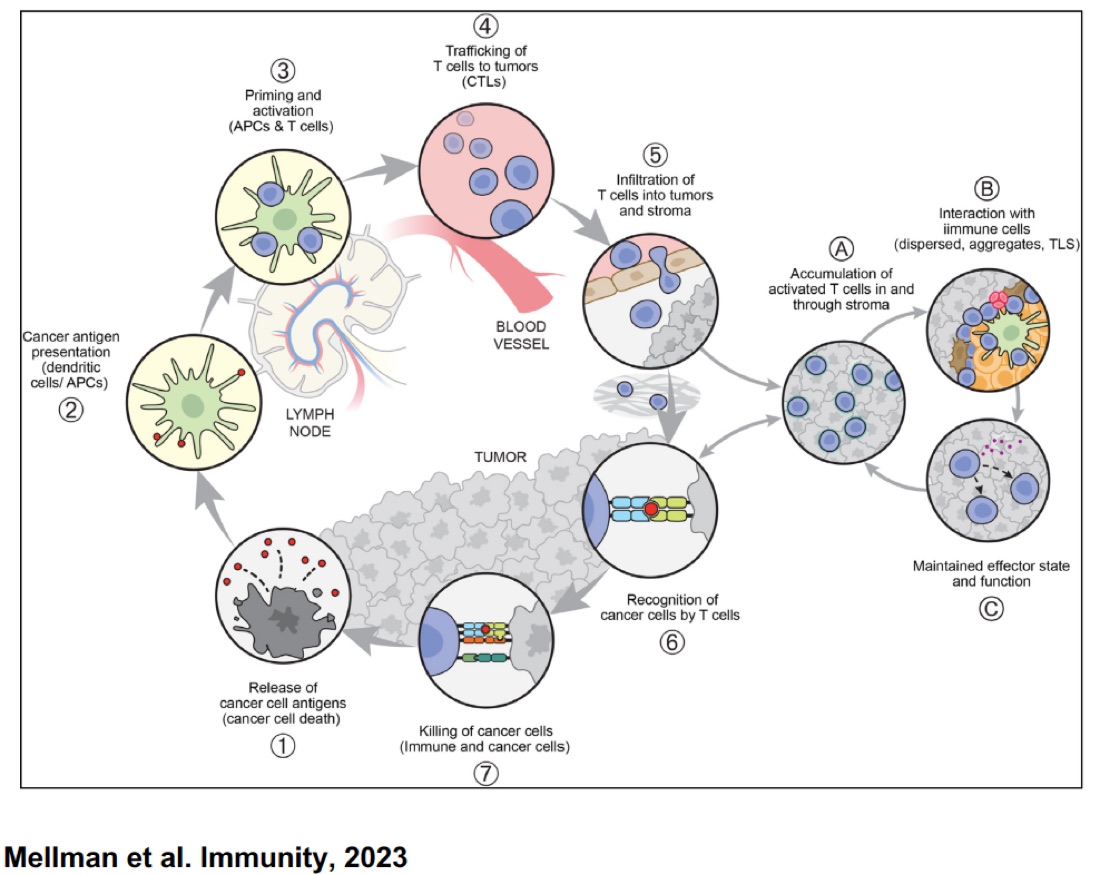
Effective anti-tumor immunity needs seven steps to work in sequence: antigen release, presentation, T-cell priming, trafficking, infiltration, recognition and killing. A personalized mRNA-DC vaccine acts on five of them. The MDT then adds agents that unblock the rest where a patient's tumor needs it: poly I:C and GM-CSF to amplify priming, low-dose cyclophosphamide to reduce regulatory T cells, anti-PD-1 to release the brake at the tumor, celecoxib or regorafenib to condition the tumor environment.
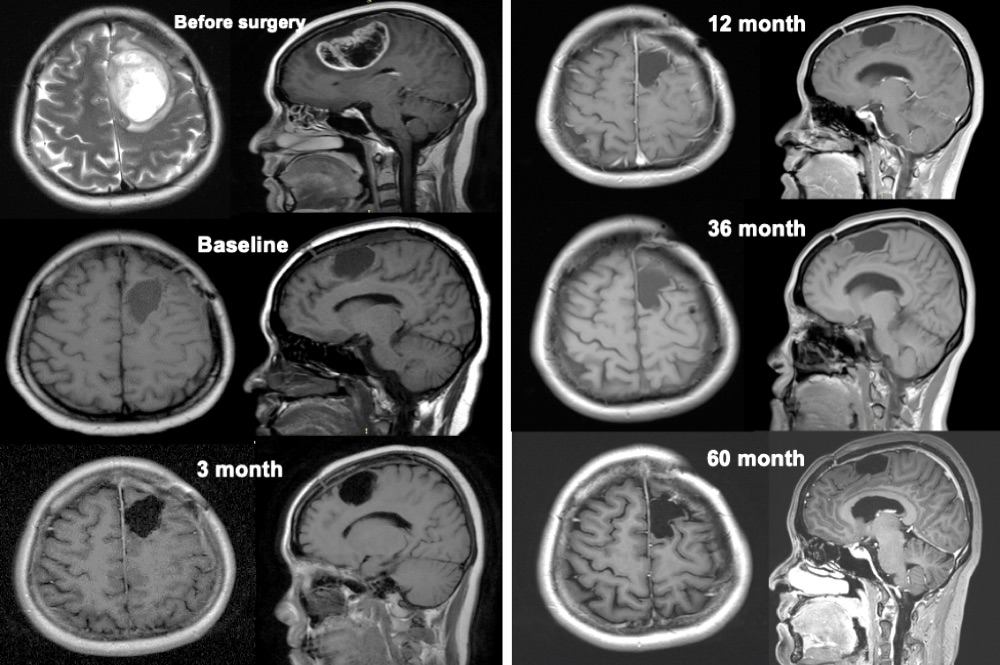
This is why the program is run as a combination immunotherapy by a multidisciplinary team, not as a vaccine alone. The published 9-year case used exactly this approach.
One lead asset, several routes
| Program | Indication | Route | Position (Oct 2026) |
|---|---|---|---|
| tri1215 | Glioblastoma | Survivin mRNA-DC | Registered Phase II in China; conditional launch targeted 2029 |
| tri1215 | Colorectal cancer | Survivin mRNA-DC | Preclinical indication expansion |
| tri1281 | GBM and other solid tumors | Personalized mRNA-DC medical technology | Authorized clinical application in the Beidaihe pilot zone; this is the patient program |
| tri1019 | Solid tumors, post-surgery with anti-PD-1 | Survivin mRNA-tLNP (in-body) | Preclinical; IND targeted 2027. Pilot-zone use authorized with human safety testing completed |
| tri1020 / tri1032 | Nasopharyngeal / bladder cancer | mRNA-tLNP | Earlier-stage; Phase I targeted 2028 |
| tri1027 / tri1020 / tri1030 | HPV, EBV high-risk groups; pan-cancer prevention | mRNA-tLNP prevention | Proof of concept; first personalized therapeutic HPV filing under the new framework, October 2026 |
Dates are management targets, not committed approvals.
Two tracks, both inside the system
NMPA / CDE
tri1215 is in registered Phase II with China's drug regulator. Pharmaceutical-grade raw materials carry DMF filings. This track leads to a marketing approval.
State Council Order No. 818 · Beidaihe pilot zone
Since May 1, 2026, Order No. 818 gives clinical application of new biomedical technologies a national legal basis in two designated zones, Beidaihe and Bo'ao. Tricision's personalized DC technology was the first brain-tumor project authorized in the zone, with a filed price per course, and was treating patients before the Order took effect. This track is how international patients are treated today.
Who built this

Prof. Youwen He, MD, PhD · Founder and Chairman
Tenured professor of immunology at Duke University for 25 years; over 40 years in immunology and cancer immunotherapy; 170 publications with a cumulative impact factor above 1,500. American Cancer Society Research Scholar Award. Special expert to the US HHS National Vaccine Program on vaccine safety; NIH grant reviewer; member of the American Association of Immunologists. Distinguished Professor at Peking Union Medical College; former director of the Immunotherapy Center at China's National Center for Translational Medicine; former member of the five-person expert panel of China's National Major Science and Technology Project on Infectious Diseases. Invited by Hepatology to explain triVac. Founded two earlier companies: QuantoBio (NEEQ-listed 2016, acquired by Hillhouse 2021) and Trinomab (co-founded 2010, STAR Market listing July 2026).
- 20+ years in pharmaceutical operations
- Merck (MSD), Fresenius and Ipsen
- Has led teams of about 1,000
- 20 years in drug R&D
- HD Biosciences / WuXi AppTec
- National research-project leadership
- Chair professor at Johns Hopkins University
- Leads the C2-tLNP delivery program
- Chen Zhinan, Chinese Academy of Engineering
- Li Lanjuan, Chinese Academy of Engineering
- Zheng Shusen, Chinese Academy of Engineering
- Neurosurgeons from Beijing Tiantan Hospital
- Full team on the patient page
- Riverhead Capital
- CICC Capital funds
- Hainan provincial medical and industrial capital
Where the work is done
Where this sits among mRNA cancer vaccines
| Program | Approach | Clinical position, October 2026 |
|---|---|---|
| Moderna / Merck, intismeran | Personalized mRNA neoantigen vaccine + pembrolizumab, in-body LNP | Phase III topline benefit reported in adjuvant melanoma (August 2026); OS follow-up ongoing |
| BioNTech, BNT122 | Personalized mRNA neoantigen vaccine | Phase II combination study in resected pancreatic cancer continues |
| MimiVax, SurVaxM | Survivin peptide vaccine | Randomized Phase IIb in newly diagnosed GBM reported (October 2026): OS 22.8 vs 20.3 months, HR 0.75, p=0.076 |
| Tricision, tri1215 | Survivin mRNA loaded into autologous dendritic cells, triVac-engineered | Registered Phase II in newly diagnosed GBM; Phase I low-dose mPFS 15.4 months |
| Tricision, C2-tLNP | cDC1-targeted in-body mRNA delivery | Preclinical; human safety testing completed under pilot-zone authorization |
The approach has been validated at the top of the industry: AbbVie's acquisition of Capstan (targeted LNP, up to US$2.1bn, 2025), BMS's acquisition of Orbital (US$1.5bn, 2025) and Lilly's acquisition of Orna (up to US$2.4bn, 2026) were all for targeted or circular RNA delivery platforms. These are industry examples, not valuation comparables.
Read the sources
- Zhu et al. A GBM case with combination immunotherapy of personalized mRNA-DC vaccines, anti-PD-1, poly I:C and cyclophosphamide integrated with standard chemoradiation, disease-free for 69 months. Journal of Pharmaceutical Analysis 2023;13(6):616–624. doi:10.1016/j.jpha.2023.04.012
- Individualized combined immunotherapy regimens yield potential survival benefits for glioblastoma patients. Biomedicine & Pharmacotherapy 2025;184:117858.
- Revolutionizing cancer treatment: the power of dendritic cell-based vaccines in immunotherapy. Biomedicine & Pharmacotherapy 2025 (review citing the Tricision case).
- triVac antigen modification. PubMed 32767586; Hepatology invited commentary by Prof. He.
- Mellman I, et al. The cancer-immunity cycle: indication, genotype, and immunotype. Immunity 2023.
- Stupp R, et al. Radiotherapy plus concomitant and adjuvant temozolomide for glioblastoma. NEJM 2005. doi:10.1056/NEJMoa043330
- Phase II registration: CTR20261465, Center for Drug Evaluation, NMPA. Company clinical page
- US Patent 12,508,225 B2 (C2 lipid), granted December 2025.
Data room, referrals and collaboration
Refer a patient
Submit records on a patient's behalf through the records-review form. You receive the MDT report, can join the consultation remotely and remain the treating physician at home.
Full datasets under CDA
Phase I clinical study data, the pooled analysis, triVac and C2-tLNP experimental packages and manufacturing documentation are available to qualified physicians, institutions and partners under a confidentiality agreement. Write to ryanzhang@tricisionbio.com.